
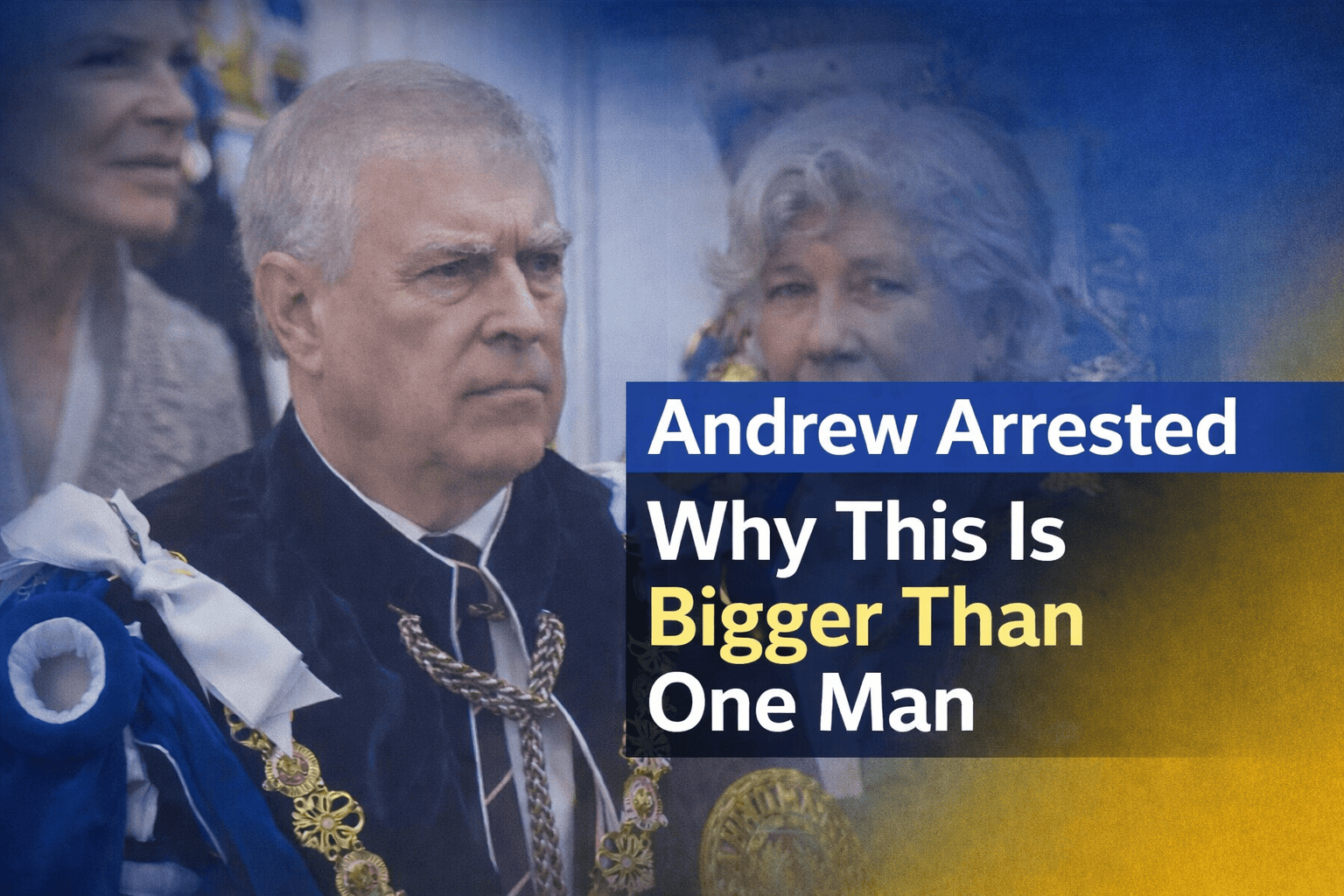
When I read the breaking news — and as my team began reporting on the arrest of former Prince Andrew — it felt deeply shocking, even though many of us sensed this moment had been building for years. The arrest of Andrew Mountbatten-Windsor marks one of those rare occasions when a single news event reveals something far larger about a nation, its institutions, and the fragile nature of public trust.
Regardless of personal views about the Royal Family, what unfolded this week represents a constitutional and cultural turning point — not because of who was arrested, but because of what the arrest symbolises.
For decades, Britain has balanced tradition with accountability. Now those two forces are colliding in full public view.
The end of assumed immunity
The monarchy has long existed within a delicate understanding: politically neutral, symbolically powerful, and largely insulated from the rough edges of everyday public scrutiny.
That insulation has been steadily eroding.
The modern public does not view status the way previous generations did. In the age of transparency, social media, and permanent digital records, hierarchy carries far less protection than it once did.
The message many people will take from this moment is simple — rightly or wrongly — that institutional privilege no longer guarantees distance from legal processes.
And that perception alone matters.
A media landscape that no longer waits
The speed at which the story broke says as much about journalism today as it does about the investigation itself.
The arrest announcement was broadcast live, analysed instantly, and debated globally within minutes. There was no gradual shaping of public understanding, no slow editorial filtering. Instead, audiences watched history unfold in real time.
This is the new reality: institutions now respond to events at the pace of the news cycle, not the other way around.
For the Royal Family — historically careful, measured, and controlled in communications — this represents unfamiliar territory.
Trust, not titles, is now the currency
The deeper issue here is trust.
Public confidence in institutions across Western societies has been declining for years — governments, media, corporations, and yes, monarchies.
Events like this do not create distrust; they reveal existing fractures.
Many citizens will see the arrest as proof that accountability works. Others will see it as evidence that problems were allowed to linger too long before action was taken.
Both reactions highlight the same underlying reality: legitimacy today depends less on tradition and more on transparency.
The Royal Family’s modern challenge
The monarchy’s survival in the 21st century has depended on adaptation. From televised coronations to social media engagement, it has evolved when necessary.
But reputational crises are different from ceremonial change.
The Royal Family must now navigate a world where public patience is shorter, scrutiny is relentless, and narratives form instantly online — often before official statements are even drafted.
How the institution responds in tone, openness, and consistency may matter more than the legal outcome itself.
A broader national moment
This story is not ultimately about personalities; it is about expectations.
Britain is redefining how authority and accountability coexist. The public increasingly expects equality before the law not just as a principle, but as a visible reality.
If that expectation is met, trust may strengthen.
If it is not, scepticism will deepen.
Either way, the arrest signals a shift that extends far beyond royal headlines.
It reflects a country negotiating what fairness looks like in modern Britain — and discovering that reputation alone is no longer enough.
I still feel sadness for his wider family who this has damaged. Imagine how his children feel and you cant help feel a sense of sadness for them all?
Nick Marr is a publisher, entrepreneur, and commentator on media, business, and society.
see the breaking news at My Wokingham news platform here https://mywokingham.co.uk/news/arrested-former-duke-of-york-andrew-mountbatten-windsor-in-major-police-investigation-linked-to-epstein-files/